MedlinePlus has the honest answer: the most serious burns can be painless. Whoever wrote the page he landed on had about two sentences to tell him that clearly… and odds are that writer never set foot in medical school.
That moment is the whole job. So if you've been reading every post on medical copywriting tips you can find and wondering whether you're even allowed in the room without a nursing license, you are. Your starting point is research and translation, and the medical knowledge builds from there.
Most of what a clinic publishes for patients, like service pages, appointment emails, and blog posts, doesn't call for a clinical degree. It calls for accuracy and plain words, plus a working knowledge of the rules you can't bend. I've spent five-plus years writing for clinics, and this is exactly what I'd tell any beginner on day one.
TL;DR Quick Answers
Medical Copywriting Tips
The best medical copywriting tips come down to one rule: get it accurate first, then make it persuasive. A worried patient acts on a copy that's clear and backed by a named source.
Lead with the patient's question, not the clinic's credentials.
Translate the jargon. "Numb" beats "insensate" every time, as long as the fact stays intact.
Name your source. Cite MedlinePlus or the CDC instead of writing "studies show."
Know the rules. The FTC governs health claims, and HIPAA governs patient stories and reviews.
Get an expert review before anything goes live.
Top 5 Takeaways
Patient-facing medical copy rarely calls for a clinical degree. Pharma and clinician-facing work is where a science background usually comes into play.
Research is the skill that pays the bills. Trace every claim to a trusted primary source, never another marketer's blog.
Plain language keeps the fact and changes the words around it, which makes it a form of precision.
Learn the FTC, HIPAA, and FDA basics early, since each one shapes what medical copy can say.
Start narrow and get reviewed. One niche, a few cited samples, and an expert's red pen will take you further than any credential.
What Medical Copywriting Is (and What It Isn't)
Medical copywriting is sales writing for healthcare, and it answers to a higher accuracy bar than just about any other kind.
Copywriting is any writing meant to get a reader to act, whether that means booking the visit, making the call, or simply reading on. Medical copy puts that same craft in front of a reader who's often scared, sometimes hurting, and deciding something about their own body.
Medical writing is a different job altogether. Medical writers produce journal articles and regulatory filings that experts read. Both jobs demand accuracy, but they serve very different readers.
Where a Healthcare Background Actually Matters
The closer your reader is to the general public, the less a clinical background matters. Here's roughly how it breaks down:
Patient-facing copy: the clinic web pages, emails, blog posts, and ads that patients and caregivers read. No degree required. Research skill and clarity do the heavy lifting.
Professional and pharma promotional copy: the material doctors, pharmacists, and buyers read. Employers here often want a science degree or industry experience.
Regulatory and clinical documents: this is medical writing proper. Regulators and researchers read it, and employers usually require an advanced science degree.
So if one article told you a science background is a must and another said it barely matters… They're both right. They're just describing different jobs.
Why an Outsider's Eye Can Be an Advantage
You read like the patient does, and that's worth more than most beginners realize.
Clinicians spend years learning a second language, and after a while they stop hearing it. "Full-thickness" sounds like plain English to a burn nurse. To a grandmother reading a discharge sheet in a hospital parking lot, it sounds like gibberish.
I've sent clinic drafts back with a single note in the margin: "Your patients won't know this word." The doctor who wrote it couldn't see the problem anymore. A newcomer spots it in about four seconds.
There's a catch, though. Fresh eyes only help if you close the knowledge gap, because a confident outsider with sloppy research is exactly how wrong information ends up on a clinic's website.
Medical Copywriting Tips for Beginners: The Skills to Build First
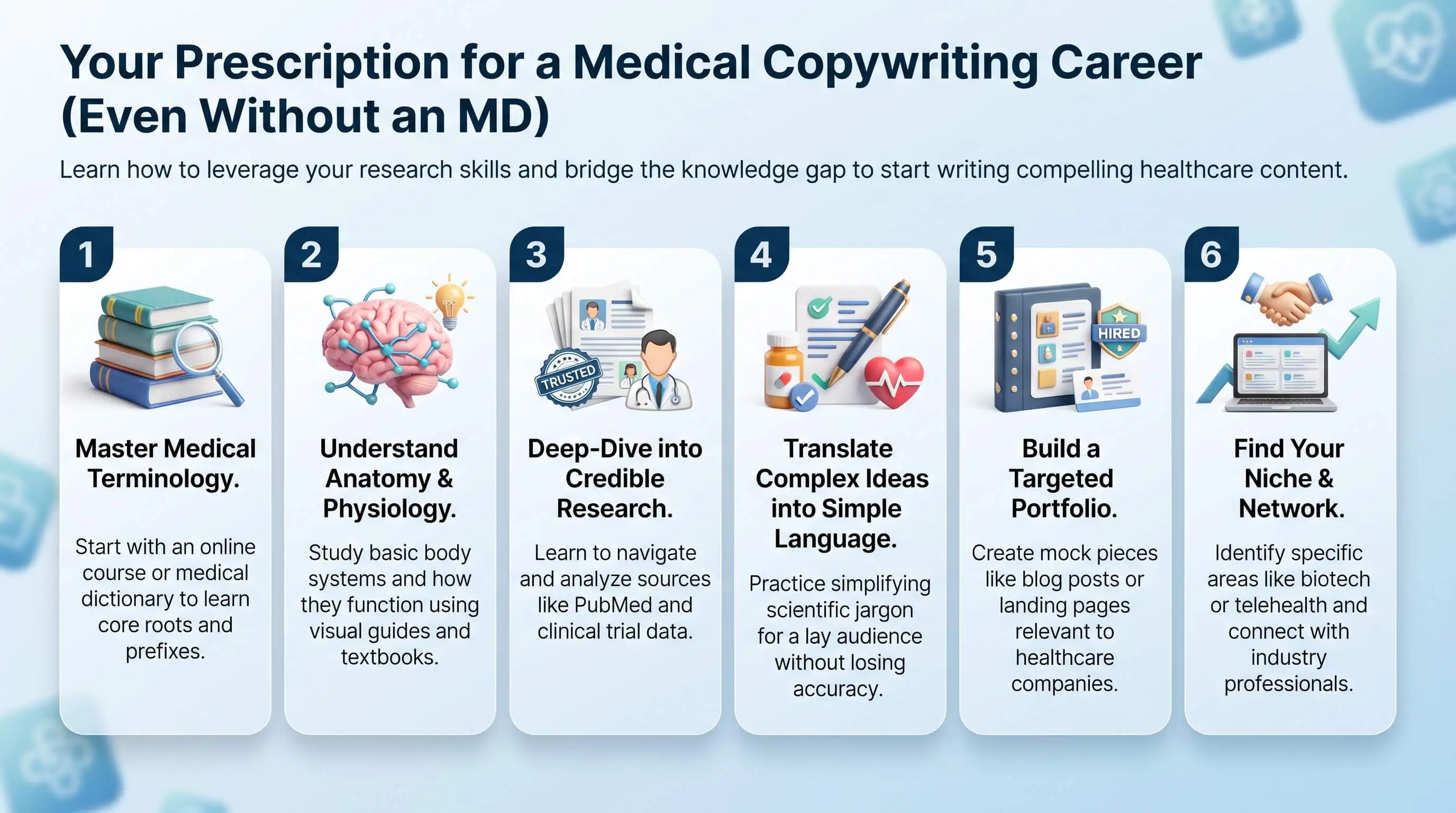
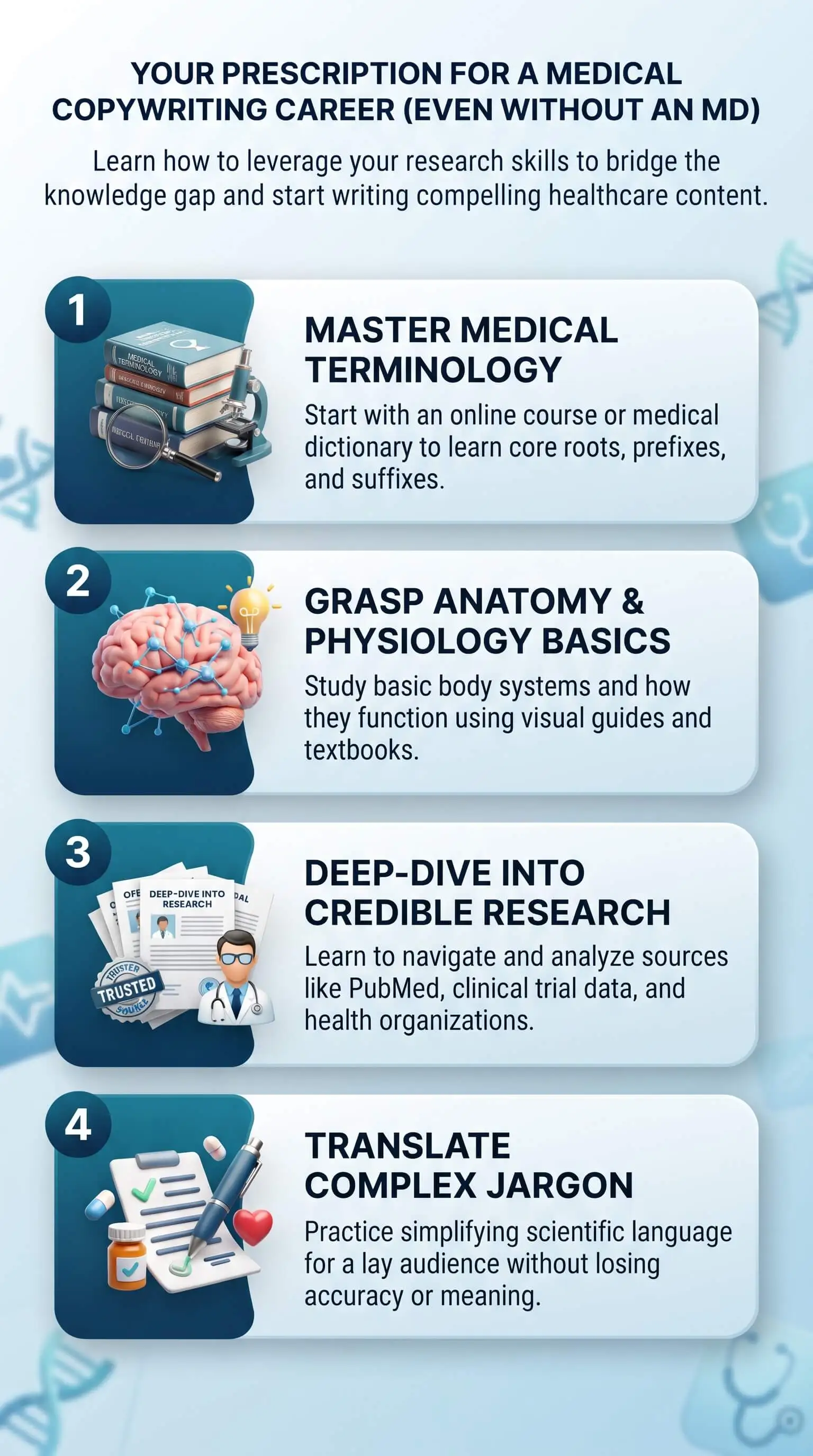
Four skills matter more than any credential when you're starting out, and none of them require a lab coat.
Research Like a Fact-Checker
Every claim needs a source you'd be comfortable showing a doctor. I start with government and nonprofit patient pages like MedlinePlus and the CDC, then move to peer-reviewed studies on PubMed when a claim needs more depth.
Another marketer's blog is NEVER proof. Keep a citation log with the claim, the source, and the date you checked it. It feels tedious, and it's also the habit that keeps clients coming back.
Translate Jargon Without Losing Accuracy
Plain language is precision a normal person can use, and it has nothing to do with dumbing anything down.
Swap "edema" for "swelling" and "insensate" for "numb." When a technical term matters to the reader, keep it and explain it right beside it. The NIH's Clear & Simple guide recommends exactly that.
Learn the Rules Before You Write a Claim
Three sets of rules show up on almost every healthcare project:
FTC: health claims have to be truthful and backed by competent, reliable scientific evidence.
HIPAA: a clinic can't put a patient's story or review into its marketing without that patient's written authorization.
FDA: prescription drug promotion plays by its own strict rulebook.
You don't need a law degree. You do need to recognize the moment to stop and ask, "Can compliance take a look at this line?"
Write for a Worried Reader
Lead with the reader's question instead of your client's credentials. Keep sentences short and give them one obvious next step.
Once those basics click, work through these medical copywriting tips from a working medical copywriter to see where beginners usually slip.
A Worked Example: Rewriting a Burn-Care Page for Patients
Burn-care pages make a great training ground. The reader is frightened and the terms are clinical, so one wrong fact can do serious harm.
Here are three rewrites I'd make, along with the fact I checked before keeping each one. Every medical detail comes from the MedlinePlus burns entry.
Rewrite 1: The clinical definition
Before: "Full-thickness burns involve the deep layers of the skin and may be insensate."
After: "A third-degree burn goes through the deep layers of skin. It may look white or blackened, and it might not hurt at all. No pain doesn't mean it's minor."
Accuracy check: MedlinePlus says full-thickness burns can leave skin numb and that the most serious burns can be painless.
Rewrite 2: The vague next step
Before: "Seek prompt medical attention for severe burns."
After: "Call 911 for a third-degree burn, a burn about the size of your palm or bigger, or any burn from chemicals or electricity."
Accuracy check: this matches the MedlinePlus list of when to call emergency services.
Rewrite 3: The overpromise
Before: "Our treatment heals burns without scarring."
After: "Fast, proper care gives a burn its best chance to heal well, though deeper burns can still scar."
Accuracy check: MedlinePlus notes burns can leave permanent scars, so the original line promises a result nobody can back up.
Now see how this site handles what qualifies as a 3rd-degree burn and when to seek emergency care for burns, then try rewriting a paragraph on your own.
This example is for writing practice. For a real burn, follow emergency guidance from a medical professional.
Your First 30 Days: A Starter Plan
You can get from zero to a pitch-ready portfolio in about a month, as long as you stay narrow.
Week 1: Pick one niche. Burn and wound care, dental, physical therapy… just one. You'll pick up its vocabulary faster and sound credible sooner.
Week 2: Build your research kit. Bookmark your go-to sources and start a plain-language glossary of about 50 terms from your niche.
Week 3: Write a handful of cited spec samples. A service page, a patient email, and a short blog post will do. Label each one clearly as a sample.
Week 4: Get a review, then pitch. Ask a clinician or an experienced health editor to check your facts. Then put up a simple portfolio page and reach out to 10 small practices or agencies.
Beginner Mistakes to Skip
Most early mistakes come from trying to sound credible instead of doing the work that makes you credible.
Borrowing claims from competitor sites. If they got it wrong, now you did too.
Citing a secondary source as proof. Trace every claim back to the original.
Writing above the reader's level. Big words won't calm a worried patient down.
Skipping expert review. Your early drafts should always get a second set of clinical eyes.
Trusting AI drafts blindly. AI tools can invent facts and even citations, so check every single one.
How to Land Your First Medical Copywriting Clients
Clinics and agencies will hire you for your samples and your process. Your résumé barely comes up.
Small private practices and healthcare marketing agencies are the usual first buyers, with health-tech startups close behind. Agencies especially need a writer they can call for overflow work, just not, like… ALL the time.
In your pitch, share one cited sample, name your niche, and explain how you check facts. That last part carries the most weight. A clinic owner's biggest fear about a non-clinical writer is getting something wrong, so answer that fear before they ever have to ask. If you're positioning yourself as a copywriter Spokane WA healthcare providers can trust, make your fact-checking process clear from the start.
"The best beginners I've worked with weren't the ones who knew the most medicine. They were the ones most nervous about being wrong. That nervousness makes you check the source twice, ask the doctor the 'dumb' question, and cut any line you can't back up. In five-plus years of writing for clinics, nobody has ever told me a page was too clear. Plenty of patients have quietly clicked away from pages that weren't. Be careful and kind on the page, and the medical knowledge will come. I still look up things I've written about a dozen times."
Essential Resources
Seven places I'd send any new medical copywriter. Skim the ones that fit where you are right now.
1. See What the Job Actually Involves
The American Medical Writers Association lays out what medical copywriters do, who hires them, and which skills to build first. I like that AMWA is upfront about people coming into this field from all kinds of backgrounds.
Source: AMWA: What Do Medical Copywriters Do?
2. Learn to Write for Every Reading Level
The NIH's Clear & Simple guide walks health communicators through building materials that people with limited health literacy can actually use. Its section on explaining technical terms is worth the visit by itself.
Source: NIH: Clear & Simple
3. Practice Plain Language the Way the Government Does
Digital.gov's plain language series shows you how to write, design, and test content so the people reading it understand it. Every bit of it applies to a clinic's service page.
Source: Digital.gov: Plain Language Guide Series
4. Go to the Research Yourself
The National Library of Medicine runs PubMed, a free database of more than 40 million biomedical citations. When a claim needs more than a patient-education page, start here instead of with somebody else's summary.
Source: PubMed: About
5. Check Medical Facts Against a Trusted Reference
MedlinePlus is where I check basic medical facts before they go anywhere near a patient's copy. Its burn entry is a terrific model of clinical accuracy written for regular people.
Source: MedlinePlus: Burns
6. Know What You're Allowed to Claim
The FTC's health guidance explains why health claims need solid scientific backing, and why soft hedges like "may help" won't rescue a weak claim. Read it before you write your first headline.
Source: FTC: Health Products Compliance Guidance
7. Handle Patient Stories the Right Way
HHS explains when a healthcare provider needs a patient's written authorization before using their health information in marketing. If a client hands you a stack of testimonials, this is your gut-check.
Source: HHS: HIPAA Marketing Guidance
Supporting Statistics
Three numbers that shape how I think about this work, and why there's room in it for you.
1. More than half of U.S. adults look up health information online.
During the second half of 2022, 58.5% of U.S. adults had used the internet in the past year to look for health or medical information. That's the audience for every clinic page you'll ever write. In my experience, they show up with a question and go with whoever answers it clearly.
Source: CDC/NCHS: Health Information Technology Use Among Adults, July–December 2022
2. Burns caused an estimated 163,000 deaths worldwide in 2023.
The World Health Organization attributes about 163,000 deaths in 2023 to fire, heat, and hot substances, and it notes that figure doesn't even capture every kind of burn. With stakes like that, a vague "seek medical attention" won't cut it. Clear instructions are part of the care.
Source: World Health Organization: Burns Fact Sheet
3. About 65% of U.S. writers and authors are self-employed.
The Bureau of Labor Statistics counts roughly 140,300 writer and author jobs in 2025, and self-employed workers hold about two out of three. BLS also projects around 11,900 openings a year through 2035. For a career changer, that's good news, since most of this field already runs on freelancers.
Source: U.S. Bureau of Labor Statistics: Writers and Authors
Final Thoughts & Opinion
You don't need a healthcare background to write a good medical copy. What you need is a healthy fear of getting it wrong.
After years of writing for clinics, I've noticed a pattern in the beginners who stick around:
They pick a lane. One niche learned well beats ten skimmed.
They show their work. Every claim has a source they can hand over on request.
They ask for review without flinching, because a clinician's red pen is free training.
They keep learning. Each new client is a crash course in another specialty.
Honestly, I'd hire a careful newcomer over a confident expert who never checks a fact, every single time.
If you're still on the fence, try one small test. Pick a page on this site, rewrite one paragraph for a scared reader, and check every fact against MedlinePlus. Enjoyed that more than you expected? Well… that's your answer.
Frequently Asked Questions
Q: Do You Need a Medical Degree to Become a Medical Copywriter?
A: Not for patient-facing work. Clinics and healthcare marketing agencies hire for accuracy, research discipline, and clear writing. Pharma companies, and anyone writing copy aimed at doctors, more often expect a science degree or industry experience.
Q: What Are the Best Medical Copywriting Tips for Beginners?
A: Research before you write a word, and translate jargon without dropping the fact underneath it. Back every claim with a named source. Write to one worried reader instead of a crowd. Then have an expert review your work before it goes live.
Q: How Long Does It Take to Learn Medical Copywriting?
A: You can pull together the basics and your first spec samples in a few weeks. Real confidence in a niche takes longer, and you earn it through actual projects, client feedback, and a LOT of fact-checking. Expect to keep learning for as long as you do this work.
Q: Can I Use AI to Write Medical Copies?
A: Sure, for outlines and rough first drafts. Never as the final word, though. AI tools can invent facts and even fake citations, so you have to check every claim against a primary source before a patient ever reads it.
Q: How Do I Build a Portfolio With No Clients?
A: Write two or three spec pieces in one niche. Label them clearly as samples and cite your sources. Then ask a clinician or an experienced health editor to review them, since reviewed samples carry a lot more weight in a pitch.
Ready to Write Your First Piece of Medical Copy?
Nobody hands out permission slips for this, and you won't need a lab coat. Start with one paragraph and one trusted source, then keep rewriting until a scared reader would get it on the first try.
This week, pick a burn-care page on this site, rewrite one paragraph in plain language, and check every fact before you call it done. If you're stuck on where to start, or you'd like a second opinion on your rewrite, drop it in the comments below.


